80th birthday ideas
that celebrate a whole life.
The best 80th birthday ideas celebrate the life as much as the day: a book of photos and stories from all eight decades, messages from the family, a party built around their favourite people, places and music, and time for them to tell their own stories. If you are hoping for an official card, the King’s birthday messages start at 100, not 80.
Someone turning 80 in 2026 was born in 1946, so a book of their life runs from post-war baby photos to this year’s. The ideas below draw on advice from the Library of Congress, RNID and the Oral History Society. Most cost little but time; anything printed needs three or four weeks.
What do you give someone turning 80?
By 80, most people own what they need. What they rarely have is their whole life in one place. The gifts that land are about the life, and the family can make most of them together:
A book of their eight decades. Photos from every decade of their life, with names, places and years in the captions, ending with the family as it is now. How to make one is below.
Eighty memories. Ask children, grandchildren, old friends and neighbours to write down one memory of them each, and collect the cards in a box or a book. Eighty is a good target, and nobody has to write much.
Every generation in one photo. Ask a photographer, or a patient grandchild, for ten minutes at the party, and frame the result.
A day back. Take them to the street, school, seaside town or dance hall where a big moment of their life happened, with a camera and a notebook.
The soundtrack of their youth. The first UK singles chart was published in NME on 14 November 1952, when someone born in 1946 was five or six, and the Official Charts website lets you browse past charts by date. Make a playlist of the number ones from the weeks they turned 16 and 21.
Most of our gifts for grandparents suit an 80th too.
How do you make a memory book of eight decades?
Give each decade of their life its own section and let the photos lead. For someone born in 1946, the decades fall like this, with a few things to look for in each:
Their eight decades
- Birth to 9 (1946 to 1956): baby photos, first school, the Coronation in 1953
- 10 to 19 (1956 to 1966): school photos, first jobs, first records
- 20 to 29 (1966 to 1976): leaving home, courting, weddings
- 30 to 39 (1976 to 1986): first homes, young children, holidays
- 40 to 49 (1986 to 1996): work, celebrations, family milestones
- 50 to 59 (1996 to 2006): weddings, new arrivals, travel
- 60 to 69 (2006 to 2016): retirement, hobbies, grandchildren
- 70 to 79 (2016 to 2026): the family as it is today
Ask everyone for photos six weeks ahead.
The photos from the 1950s and 60s are usually in a sibling’s loft or a cousin’s album. Tell people which decades you are missing, and ask for the story behind each photo as well as the picture.
Scan the prints properly.
The Library of Congress advises scanning 4×6 and 5×7 inch prints at 300 dpi, and at 400 or 600 dpi to enlarge them to 8×10 inches or more, which a full-page photo in a book may need. Our guide to digitising old photos covers the rest.
Caption every photo.
Names from left to right, the place and the year. Ask the birthday person quietly, before the day: they are the one who knows who the girl in the hat is. Our guide to what to write in a memory book helps with the words.
Add papers, not just photos.
A ration book, a wedding invitation, an old payslip or a letter, scanned at the same settings, often says as much as a photo.
Order three weeks ahead.
Printed books are made to order and posted, so leave at least three weeks before the party.
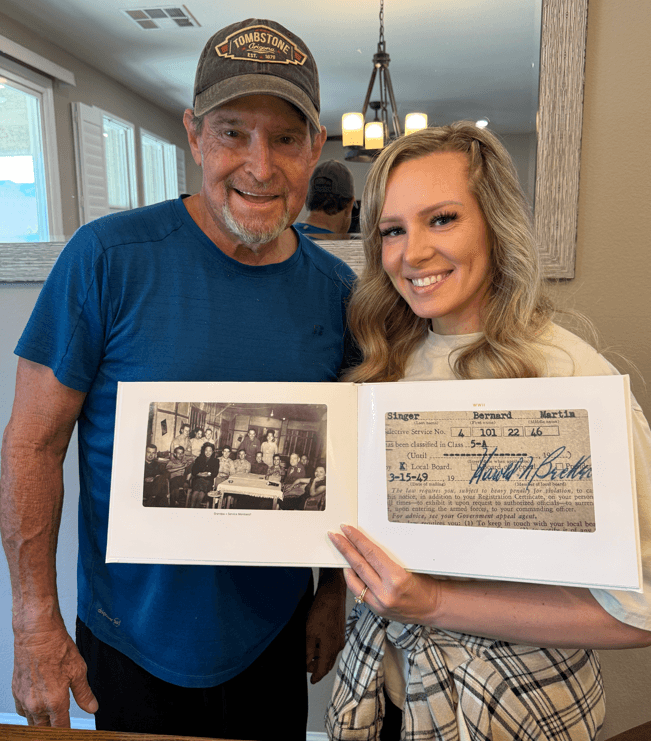
In the book Alison made for her dad, an old black-and-white family photo sits opposite a document from 1949.
What makes a good 80th birthday party?
Build it around their people and their stories rather than a theme.
Invite someone from every decade. A school friend, an old colleague, a neighbour from the first house. Ask each guest to bring one photo and one memory written on a card.
Set out the photos by decade. Eight piles of prints or eight frames, from 1946 to now, and watch who stops at which.
Play their music. The chart playlist from above, kept low enough to talk over.
Plan for hearing. RNID says almost 80% of people over the age of 70 will have hearing loss. Choose a room without echo, turn the music off for speeches, use a microphone and seat the birthday person where they can see faces.
Keep the speeches short. Two or three speakers for a couple of minutes each, then offer the birthday person the microphone.
Eighty years of stories. Make sure someone is writing them down.
What if they don’t want a fuss?
Plenty of people would rather skip the party. A quiet day can still mark eight decades:
Lunch at a favourite place, with the four or five people they would choose.
Letters from the family, read aloud at the table or left for them to read later.
A video call from relatives who can’t be there, timed for the cake.
An afternoon with the photo box and a recorder running. The Oral History Society suggests open questions, ones which need more than a yes or no answer. Our questions to ask your grandparents are grouped by decade.
That last idea is worth doing for the youngest guests too. Emory University psychologists Robyn Fivush and Marshall Duke found that children whose families talked about difficult times in “more coherent and emotionally open ways” coped better over two years, with better self-esteem and less anxiety.
Can you get an official card for an 80th birthday?
Not from the King. The Royal Family’s Anniversaries Office sends cards for 100th and 105th birthdays and every birthday after, and for 60th, 65th and 70th wedding anniversaries and every anniversary after. A 100th usually needs no application, because the Department for Work and Pensions’ Centenarian Team tells the office who is approaching the birthday, but wedding anniversaries always need one.
More people are reaching those milestones. The ONS estimates that 625,000 people in the UK were aged 90 or over in 2024, up 53.7% since 2004, and that the number of centenarians doubled over the same twenty years, from 8,300 to 16,600.
In the US, presidential greetings are requested through the White House’s online form at whitehouse.gov/greetings. Congressional offices, such as Representative Delia Ramirez’s, describe birthday greetings as available from the 80th birthday (the 70th for veterans) and ask for requests to arrive six weeks before the date. The form itself, checked in October 2026, accepts any adult’s birthday, so an 80th qualifies either way.
How Ancestorii can help.
If the gift is a book, Ancestorii lets the whole family build it together. Invite everyone into one private family space, by email, a shareable link or a join code, and ask them to add their photos to the shared Library. Then design a Memory Book on the website: an A4 landscape hardcover. A Legacy has 46 memory pages (48 printed) for £64.99 plus delivery, which gives each decade five or six pages, and A Story has 36 printed pages for £54.99 plus delivery.
You can preview the book spread by spread and download a free PDF before you order, and the optional writing help can suggest chapter introductions for you to edit. Each order prints one copy. Prints ship to 20 countries, and standard delivery takes 10 to 14 working days, so order about three weeks ahead.
Alison, whose book for her dad is pictured above, put it simply: “I walked past my dad’s room and caught him looking through his memory book again. That’s the third time this week.”
After the party, keep the stories coming: send them questions from the Ancestorii app, any of 46 ready-made ones or your own. They answer in the free iPhone or Android app, and each answer becomes a memory the whole family can see. Here is how family questions work.
Questions about 80th birthdays.
What do you buy someone for their 80th birthday?
How do I make an 80th birthday memory book?
Can you get a birthday card from the King for an 80th?
How do I request a birthday card from the White House?
What can I do for an 80th birthday that’s low-key?
Sources
- The Royal Family · Anniversary messages (accessed October 2026)
- The Royal Family · 50 facts about Queen Elizabeth II’s Coronation (accessed October 2026)
- Office for National Statistics · Estimates of the very old, including centenarians, UK: 2002 to 2024 (21 October 2025)
- The White House · Presidential Greetings (accessed October 2026)
- Office of Representative Delia Ramirez, US House of Representatives · Presidential Greetings (accessed October 2026)
- Library of Congress · Scanning Your Personal Collections (Personal Digital Archiving series)
- Official Charts · The first ever Official Singles Chart revisited (14 November 2012)
- RNID · Prevalence of deafness and hearing loss (updated 18 August 2026)
- Oral History Society · For family historians (accessed October 2026)
- Emory University · How family stories help children weather hard times (29 April 2020)