Questions to ask your dad.
Ask your dad about the stories he rarely tells: his childhood, his own father, his first jobs and what changed when you were born. Use specific, open questions, ask them side by side rather than face to face, and keep his answers in his own words.
The questions below are written for dads. For a general list that suits both parents, see questions to ask your parents about their life. Dates and figures come from sources such as the National Army Museum, the Royal Mint, the Office for National Statistics and legislation.gov.uk, listed at the end.
Why ask your dad these questions?
Because the stories children grow up with seem to matter. In an Emory University study that began just before 9/11 and ran for two years, children aged 10 to 12 whose families told more coherent, emotionally open stories about hard times coped better over those two years. They had better self-esteem, higher social competence, higher-quality friendships and less anxiety and stress.
And because many families have a handful of stories Dad always tells: the car that broke down, the boss he stood up to. The questions below go underneath those, to the parts nobody has thought to ask him about.
Questions about growing up.
Start with places, people and things he can picture.
Growing up
- What did you and your friends get up to that your parents never found out about?
- What was the first thing you saved up for?
- Which teacher did you get on with, and which one couldn’t stand you?
- What did you want to be, and when did you stop wanting it?
- What was your first bike or car, and where did you go on it?
- What were you scared of as a boy?
Questions about his own dad and grandad.
Your dad may be the last person who remembers his father and grandfather at work and at home. If his father was a young man in the late 1940s or the 1950s, National Service may be part of the story. The National Army Museum explains that from 1949 it applied to all able-bodied men aged 17 to 21. It began at 18 months, rose to two years in 1950 during the Korean War, and took in more than 2 million men before the last National Serviceman was discharged on 14 June 1963.
His dad and grandad
- What did your dad do for a living, and did you ever see him at work?
- What did he teach you to do with your hands?
- Did your dad or grandad do National Service or serve in a war? Did they talk about it?
- What were you never allowed to do or say in front of him?
- What do you do that’s exactly like him?
- What would you ask him now, if you could?
Questions about work and money.
Work can be the easiest way in, because it is about what he did rather than how he felt. Money is a good thread too. Decimal Day, 15 February 1971, changed the pound from 240 pennies to 100, the Royal Mint records, so if he was earning or shopping before then, he will have known prices in shillings and pence.
Work and money
- How did you get your first job, and what was the first week like?
- What was in your first wage packet, and what did you spend it on?
- What did things cost before decimal money? Do you remember the day it changed?
- Who was the best boss you ever had, and what did they get right?
- Was there a job you turned down, or one you wish you’d taken?
- What worried you most about money when we were small?
Questions about becoming a dad.
Fathers are older than they used to be: the Office for National Statistics puts the average age of fathers in England and Wales at 34.0 in 2025, and says it has been rising since 1976. Time off has changed too. The Employment Act 2002 brought in a right to two weeks’ paid paternity leave from 2003, so if you were born before then, ask how much time he had off, and who decided.
Becoming a dad
- How old were you when I was born, and did you feel ready?
- How much time did you get off work when I arrived?
- What went through your head the first time you held me?
- What did you do differently from your own dad, on purpose?
- What was the hardest part of being a dad when we were small?
- What did you hope I’d grow up to be?
Questions only he can answer about you.
These are the stories only he can tell you.
About you
- What do you remember about the day I was born?
- What was I like as a toddler, in one story?
- What did we do together that I’m too young to remember?
- When were you proudest of me, and did you ever tell me?
- What did I get from you, good and bad?
- What do you want me to remember about you?
He has told the funny stories a hundred times. Ask for the ones he hasn’t.
When to ask: Father’s Day and other moments.
Father’s Day began in Spokane, Washington. HistoryLink records that Sonora Smart Dodd, whose widowed father had raised her and her five younger brothers, had the idea in 1909, and that the first Father’s Day was celebrated there on 19 June 1910.
In the US it became law when President Nixon signed P.L. 92-278 on 24 April 1972, designating the third Sunday in June, according to the US House of Representatives. The UK keeps the same Sunday, which is 20 June in 2027.
Father’s Day is a good excuse, but the best conversations often happen when you are doing something else together:
In the car. Side by side, eyes on the road, a question can feel less like an interview.
Fixing something. Ask how he learned to do it, and who taught him.
Over an old photo. Ask what was happening just outside the frame.
One question by message. Some dads answer best when they’ve had time to think it over.
How it helps.
In the Ancestorii app you can send him one of 46 ready-made questions in 10 chapters, including Work & Purpose and Music & Hobbies, where one asks: ‘There’s always a song that brings someone straight to mind. Which one, and who?’ You can also write your own, so any question on this page will do.
The question travels as a time-limited link. He answers in the free iPhone or Android app when he’s ready, and you get an email when he does; if he already uses the app and hasn’t answered after 24 hours, he gets one reminder. His answer is saved as a memory in your family’s private My Family feed, where your brothers and sisters can add their own memory of the same moment. See how family questions work.
If he would rather talk than type, record him telling it and add it yourself, with the voice note attached. Our guide to capturing family voices explains why the sound of him is worth keeping.
Alison, in Nevada, made a Memory Book for her dad from years of family photos. In her words: ‘I walked past my dad’s room and caught him looking through his memory book again. That’s the third time this week.’
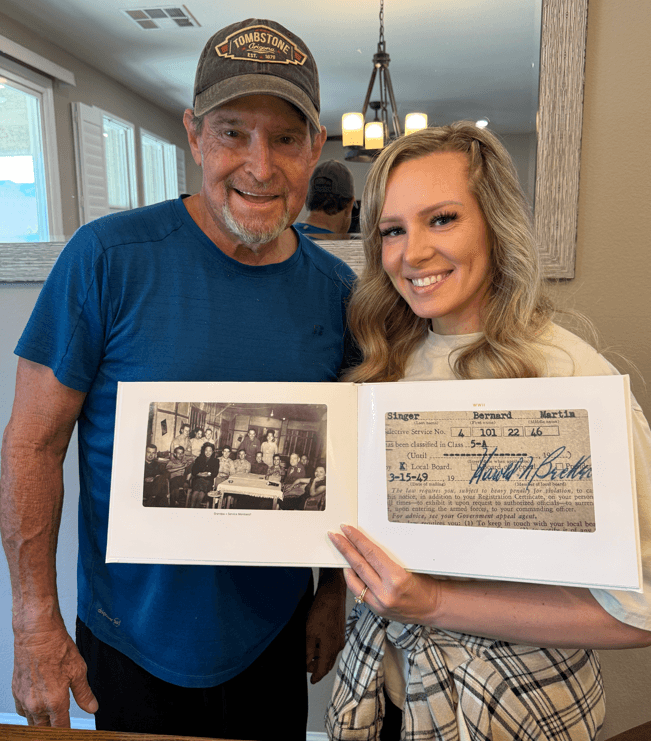
For Father’s Day, a printed Memory Book is an A4 landscape hardcover of 24, 36 or 48 pages, from £44.99 plus delivery, and a Memory Canvas starts at £99.99 plus delivery. Standard delivery is quoted at 10 to 14 working days, so order at least three weeks ahead. For his parents’ generation, see how to interview your grandparents, and for the other side of the family, questions to ask your mum.
Questions about asking your dad.
What should I ask my dad about his life?
What are good questions to ask your dad on Father’s Day?
My dad doesn’t like talking about himself: how do I start?
How do I record my dad’s stories?
What should I ask my dad about his own father?
Sources
- HistoryLink.org · Father’s Day is conceived by Spokane’s Sonora Smart Dodd and celebrated for the first time in Spokane on June 19, 1910 (Essay 9458) (17 June 2010)
- US House of Representatives: History, Art & Archives · Father’s Day Becomes A National Holiday (accessed October 2026)
- Office Holidays · Father’s Day in United Kingdom in 2027 (accessed October 2026)
- Office for National Statistics · Births in England and Wales: 2025 (final rates) (8 September 2026)
- legislation.gov.uk · Employment Act 2002: Explanatory Notes, paternity leave and Statutory Paternity Pay (2002)
- National Army Museum · What was National Service? (accessed October 2026)
- The Royal Mint · Our story: 1900-2000 (accessed October 2026)
- Emory University · How family stories help children weather hard times (29 April 2020)
- Oral History Society · For family historians (accessed October 2026)