How to write a life story.
To write a life story, start with a simple timeline of dates and places, gather stories in the person’s own words through recorded conversations, group them into chapters, add captioned photos and share drafts so family can add what they remember. Write plainly, and keep their phrases.
The same steps work for a parent’s life or your own, and for the life story books many care settings use.
What goes into a life story?
The facts of a life, the people in it and the everyday detail that made the person who they are. Dementia UK’s guide to creating a life story suggests covering:
The basics. Their name and how they like to be addressed, date of birth, where they live and the languages they speak.
The people. Family, friends, colleagues and pets, and the relationships that mattered most.
The places. Homes, schools, workplaces, holiday destinations and their children’s schools.
The big events. Childhood and education, working life, achievements, weddings, births, house moves and new jobs.
The everyday. Food they love and hate, favourite music, TV and films, routines, beliefs and values.
For a family history rather than a care setting, add the reasons behind the facts: why they moved, how they met, what they would do differently.
How do you gather the material?
Make a one-page timeline.
Birth, schools, moves, jobs, marriages, children and grandchildren, each with a year and a place. The gaps show you what to ask about.
Collect the paperwork.
Certificates, school reports, payslips, letters, passports and the writing on the backs of photos all hold names and dates.
Record the conversations.
Take one topic at a time so it never becomes overwhelming, as Dementia UK suggests, and ask open questions that need more than a yes or no answer, as the Oral History Society advises. Explain what the recording is for before you start.
Ask the rest of the family.
Brothers, sisters, cousins and old friends remember different things. If the person finds it hard to tell their story, Dementia UK notes, other family members and friends may be able to provide key information.
Our guides to questions to ask your parents and interviewing your grandparents have questions to start with and advice on recording.
How should you structure it?
Most life stories read best in chapters, each one a stage of life or a theme. Dementia UK points out that you don’t have to start at the beginning or work in chronological order, and you don’t have to include everything, just what is most meaningful. A plan that suits most lives, with a question to open each chapter:
Seven chapters
- Where it began: where were you born, and what was home like?
- Growing up: who were your friends, and what did you get up to?
- Work: what was your first job, and which job mattered most?
- Love: how did you meet, and when did you know?
- Family: what changed when the children came along?
- Later years: what have you enjoyed most since?
- What they believe: what do you want the next generation to know?
What is a life story book, and why do care homes ask for one?
A life story book is a record of someone’s life in photos and short, clear text. In dementia care it helps people see the person behind the condition. Dementia UK says compiling one can strengthen a person’s sense of identity, encourage reminiscence, bring family closer and give carers a better understanding of the person’s life, so they can provide better care. It matters to many families: dementia and Alzheimer’s disease were the leading cause of death in England and Wales in 2025, with 72,272 deaths registered, 12.7% of the total, according to the Office for National Statistics.
Dementia UK lists several formats: books, collages or memory boards, videos, memory boxes, apps and one-page profiles, which are often used in hospitals. For a book, it suggests clear text with photos, one font and size, no more than two contrasting colours, and laminated pages or punched pockets in a ring binder. Many care settings have their own format, so you may need to copy key details into their template. Alzheimer’s Society’s ‘This is me’ leaflet, now in its fourth edition and free to download, records a person’s background, the people and places that matter to them, and their preferences and routines, for use at home, in hospital, in respite care or in a care home.
Dementia UK also suggests keeping one version for family and close friends, and a second, briefer one to share with carers.
How do you write it so it sounds like them?
Use their words. Dementia UK suggests letting the person comment on a photograph and using their words as the caption: ‘remember it is their story, not yours.’
Pick one voice, first person or third, and keep to it all the way through.
Choose detail over adjectives. What he kept in his shed says more than ‘he was practical’.
Keep their sayings, nicknames and dialect, even when they look untidy on the page.
Keep it short. A page per memory is plenty, and short chapters are easier to share and add to.
A date tells you when it happened. Their words tell you what it meant.
How do you check names and dates?
Memories blur, so check the dates that matter against records. In England and Wales, the General Register Office sells birth, marriage and death certificates for £12.50, sent 4 days after you apply if you have the GRO index reference. Without one, each search costs £3.50 extra and the certificate is sent 15 working days after you apply, GOV.UK says. Scotland and Northern Ireland have their own processes.
FreeBMD, a free index of births, marriages and deaths in England and Wales covering 1837 to 1999, can help you find the right entry first. It holds more than 300 million distinct records, though not every year is fully transcribed yet.
When two relatives remember something differently, write both versions down and say whose is whose. The disagreement is part of the story.
How do you turn it into something to keep?
Decide who it is for first. A care home needs something short, sturdy and easy to read; grandchildren may want every photo. The usual choices:
A printed book. Sturdy and easy to pass round. Order a copy for each branch of the family.
A ring binder. Punched pockets let you add pages, and laminated pages survive handling, as Dementia UK suggests.
The recordings. Keep the audio with the text, so the next generation can hear the voice as well as read the words.
Copies for everyone. When it is finished, Dementia UK suggests sharing it with family, friends and professional carers.
How it helps.
In Ancestorii, each person can have a Loved Ones profile with their photo, relationship and dates, and their life story told in four chapters: Early years, Important moments, Special memories and Who they are. Each chapter comes with guiding questions and a photo, and the profile gathers every timeline, album and capsule tagged with them.
Story Assistance, optional writing help that is on by default and can be switched off, suggests prompts for each chapter. It never edits your text: you choose what to keep. Dated events can go on a timeline, which you can download as a PDF.
When it’s ready, print it as a Memory Book: an A4 landscape hardcover with 24, 36 or 48 printed pages, at £44.99, £54.99 or £64.99 plus delivery. It holds photos and written words, and you can download a free PDF of your design first. If the book is for someone with dementia, keep each page simple, one photo and a short caption, and check whether their care home has its own template.
The Free plan includes one loved one, and Premium, at £3.99 a month for the whole family, includes as many as you like. For writing the pages themselves, see what to write in a memory book.
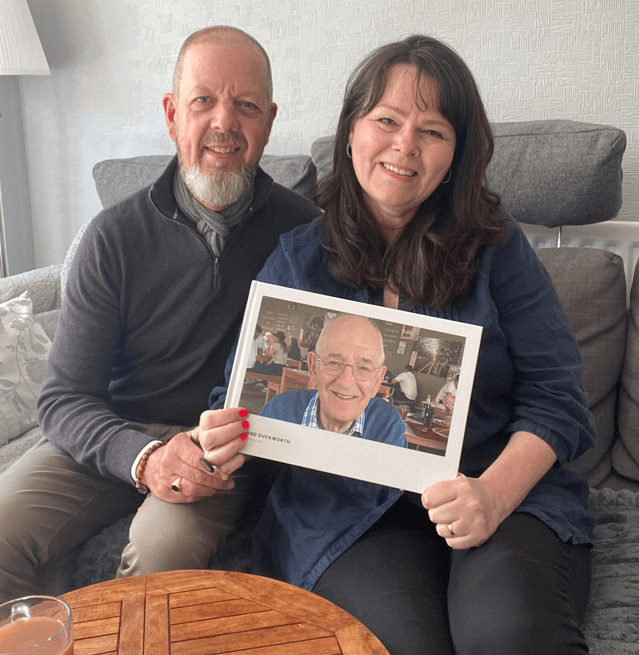
Andrea, from Dudley, has a Memory Book about her dad. In her words: ‘I recently lost my dad, so this book became incredibly special. It captured the essence of him and the life he lived.’
Questions about writing a life story.
How do I start writing someone’s life story?
What is a life story book for someone with dementia?
What questions should I ask for a life story?
Should a life story be written in the first or third person?
How do I turn a life story into a printed book?
Sources
- Dementia UK · Creating a life story for a person with dementia (leaflet DUK16) (January 2025)
- Office for National Statistics · Deaths registered in England and Wales: 2025 (25 September 2026)
- Alzheimer’s Society · This is me (accessed October 2026)
- Oral History Society · For family historians (accessed October 2026)
- GOV.UK · Order a birth, death, marriage or civil partnership certificate (accessed October 2026)
- FreeBMD · FreeBMD home page (figures updated 25 September 2026)