How to keep memories
of a loved one alive.
Keep a loved one’s memory alive by saving the things that sound and look like them, such as voicemails, messages and photos, writing down their stories while they are fresh and asking others for theirs, marking the dates that mattered, and keeping them part of family conversation.
Since the 1990s, grief researchers have challenged the idea that “letting go” is the goal. Staying connected to someone who has died can be a healthy part of grieving, and these are gentle, practical ways to do it.
Remembering them is not a failure to move on. It is part of how people grieve.
Is it healthy to stay connected to someone who has died?
Yes. For much of the 20th century, the usual view was that grief exists to cut your ties with the person who died. In 1996, the book Continuing Bonds, edited by Dennis Klass, Phyllis Silverman and Steven Nickman, challenged that view, arguing that it rested more on cultural values than on evidence, and that healthy grieving can include a continuing bond with the person who died.
So talking about them, keeping their things, cooking their recipes and marking their birthday are not signs that you are stuck. Cruse Bereavement Support says it is natural to worry about losing the memories you have of someone, and suggests finding concrete ways to honour them. There is no timetable either: the NHS says that for most people grief becomes less intense over time, but for some it lasts many months or years.
What should you save first?
Start with the things that can disappear without anyone choosing to delete them.
Voicemails.
Apple says iPhone voicemails are kept until you delete them, or until your carrier erases them if they aren’t stored in iCloud, and may be deleted if you change your SIM card. Open each one in the Phone app and tap Share to save a copy somewhere else.
Audio messages.
In Messages on iPhone, an audio message is deleted 2 minutes after you listen to it unless you tap Keep. To keep them all, go to Settings, then Apps, then Messages, and set Expire under Audio Messages to Never.
Their phone.
Google says that if an Android phone isn’t used for 57 days, the data backed up from it, except photos and videos, is erased. Copy anything you want to keep before then.
Photos and videos.
Gather them from everyone’s phones, not just yours, keep copies in two places, and add names and dates while people still know them.
Handwriting and recipes.
Scan or photograph cards, letters and recipe notes. Their handwriting is part of them too.
Our guide to saving family voices covers recordings in more detail.
How do you capture their stories before they fade?
Write things down while they are fresh, even as rough notes: the phrase they always used, the story they told every Christmas. Then ask other people. Cruse suggests getting together to share stories and favourite memories, and says you can learn things about the person you never expected.
What’s a story about them you always come back to?
One story is easier to give than a description, and it shows who they were.
What did they always say?
Write down the exact words. Sayings are quick to capture and easy to lose.
When did you first meet them?
Friends and colleagues knew a side of them the family may never have seen.
What did they teach you?
It is often a skill as much as a value: a recipe, a knot, a card game.
If the stories are for a funeral, our guide on how to write a eulogy shows how to shape them.
How can you remember them on the days that matter?
Give them a day each year. Cruse suggests choosing a day to dedicate to the person, perhaps their birthday. Its other ideas include:
Make their favourite food, from one of their recipes.
Visit a place that was special to them.
Write them a letter. Cruse says it can help you organise your thoughts and feel a sense of connection.
Plant a tree or dedicate a bench in their name.
Learn to play their favourite song, or make a video montage with it playing.
Have something of theirs repaired, such as a ring or an old teddy.
Donate to a charity that mattered to them.
People in the same family may want different things on the same day. Agree on one small thing everyone can join, and let each person mark the rest in their own way.
What happens to their social media and photos?
Each service has its own rules, and some have time limits.
Facebook. A profile can be memorialised, with “Remembering” shown above the name. When Facebook introduced legacy contacts in 2015, it said the person chosen can pin a post to the top of the profile, respond to new friend requests and update the profile and cover photos, and download an archive if allowed, but cannot log in or read private messages.
Apple. If they made you a Legacy Contact, you can request access to their Apple Account with the access key they created and a death certificate. Access lasts three years from Apple’s approval, then the account is permanently deleted, so download what you want to keep.
Our guide to what happens to your photos when you die covers iCloud, Google Photos and Facebook in more detail.
Where can you find support?
Cruse Bereavement Support. A free helpline on 0808 808 1677 for anyone in the UK affected by grief, open Monday, Wednesday, Thursday and Friday 9.30am to 5pm and Tuesday 1pm to 8pm, closed at weekends. You can also contact Cruse through its website at any time.
Samaritans. If you are struggling right now, call 116 123, free from any phone, 24 hours a day, every day of the year.
Your GP. The NHS says to see a GP if you are struggling to cope, have had a low mood for more than 2 weeks, or the things you are trying are not helping. If you are 18 or over (16 in some areas), you can also refer yourself to NHS talking therapies.
How it helps.
Give them a Loved One profile in your family’s private space: their name, photo, relationship and dates, and their life told in four chapters, Early years, Important moments, Special memories and Who they are, each with guiding questions. Invite relatives into the family space to add their own memories of them. When two people remember the same moment differently, both versions sit side by side on one page.
Upload a saved voicemail as a voice note on the photo it belongs with, so their voice sits next to their face. You can also seal a capsule of letters, photos and recordings to open on a birthday or anniversary. No notification is sent when it opens, so note the date.
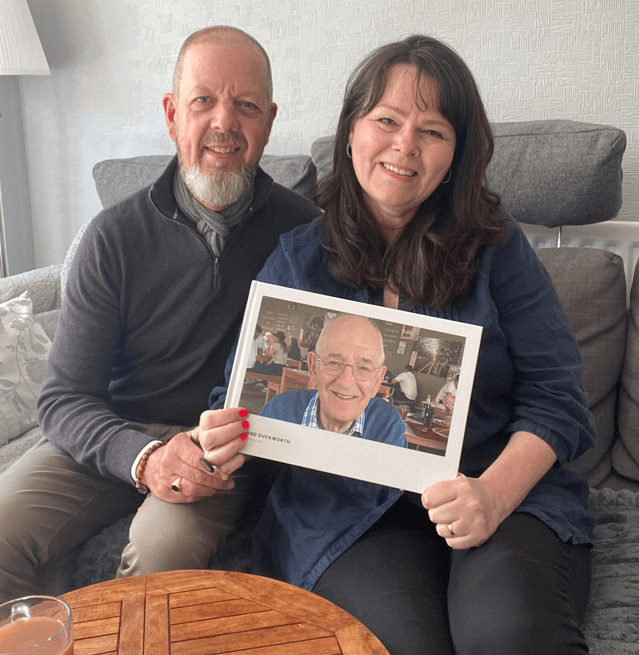
Some families also turn the photos and stories into a printed Memory Book, from £44.99 plus delivery. Andrea, from Dudley, made one after losing her dad: “It captured the essence of him and the life he lived.” The Free plan includes one Loved One profile; Premium, £3.99 a month for the whole family, covers as many as you need.
Frequently asked questions.
How can I keep my mum’s memory alive?
Is it normal to talk to someone who has died?
What should I do with a loved one’s voicemails?
How do I remember someone on their birthday or anniversary?
Where can I get bereavement support in the UK?
Sources
- Routledge · Continuing Bonds: New Understandings of Grief (Klass, Silverman and Nickman) (1996)
- Cruse Bereavement Support · Ways to remember (accessed October 2026)
- Cruse Bereavement Support · Helpline (accessed October 2026)
- Apple Support · Check your voicemail on iPhone (accessed October 2026)
- Apple Support · Send and receive audio messages in Messages on iPhone (accessed October 2026)
- Google One Help · Back up your device (accessed October 2026)
- Meta · Adding a Legacy Contact (12 February 2015)
- Apple Support · Request access to an Apple Account as a Legacy Contact (accessed October 2026)
- Samaritans · Contact us (accessed October 2026)
- NHS · Get help with grief after bereavement or loss (reviewed 14 July 2026)