How to write
a eulogy.
To write a eulogy, gather stories from family first, then write five to ten minutes’ worth, roughly 700 to 1,200 words: an opening line that brings the person to life, a short life story, two or three true stories that show who they were, what they leave behind, and a gentle close.
Then print it in large type, read it aloud a few times and ask someone to be ready to take over. The timings here come from the National Association of Funeral Directors, whose members carry out more than 80% of UK funerals, and from Humanists UK, whose celebrants help families write tributes.
Don’t tell them she was kind. Tell them the story that shows it.
How long should a eulogy be?
Five to ten minutes spoken aloud, which the National Association of Funeral Directors (NAFD) puts at about 700 to 1,200 written words. Most people speak at around 120 to 150 words a minute when they are nervous, so the same page can run long or short depending on the day.
The whole service usually lasts 30 to 45 minutes, NAFD says, and has to fit music, readings, prayers and perhaps two eulogies. Ask the funeral director or celebrant how long you have; Humanists UK says its celebrants tell each speaker the word count for their piece, so the ceremony keeps to time. If two or three of you are speaking, split the time between you. At 120 to 150 words a minute:
About 700 words takes five to six minutes.
About 1,000 words takes seven to eight minutes.
About 1,200 words takes eight to ten minutes.
Running over? Cut a story rather than speaking faster. In NAFD’s words, five heartfelt, specific minutes are “always more powerful than a fifteen-minute speech that loses focus”.
How do you gather what to say?
Talk to other people before you write. As NAFD puts it, even if you knew the person well, you may not know all aspects of their life, and family, friends and colleagues can reveal stories and qualities you were unaware of.
Ask three or four people for one story each. A sibling, an old friend, a colleague. “What’s a story about her you always come back to?” gets more than “What was she like?”
Write everything down first. NAFD suggests writing down whatever comes to mind without filtering, and shaping it later.
Collect their words. Sayings, habits, the phrase they always used. Cards, letters and photos help people remember.
Check the facts. Dates, places, jobs and names. Ask a close relative to read the life-story part before the day.
Pick two or three stories. Choose the ones that show who they were. Humanists UK suggests two to four short ones.
How should a eulogy be structured?
There is no fixed format, but NAFD suggests five parts, with rough timings.
Opening, 30 to 60 seconds.
One sentence that brings them to life, and who you are to them.
A brief life story, 1 to 2 minutes.
Where they were born and grew up, work, marriage, family. Keep it short: NAFD warns that “a chronology of facts alone does not make a moving eulogy”.
Character and stories, 3 to 5 minutes.
The heart of it. Show their qualities through specific stories instead of listing them: the exact phrase they used, the look on their face.
Legacy, 1 to 2 minutes.
What they leave behind in the people who knew them: what they taught you, what they passed on.
Closing, 30 to 60 seconds.
A favourite poem or quote, a few words to them directly, or a simple goodbye. Don’t rush it.
Humour belongs if it was part of them. NAFD says it should be affectionate, the kind that “would have made the person themselves smile”, and Humanists UK adds that if you tell a funny story you should smile, because people sometimes need permission to laugh at a funeral.
How do you start and end a eulogy?
Skip the throat-clearing. NAFD advises against opening with “I was asked to say a few words today” and suggests a first sentence that brings the person to life. Specific beats general.
For the end, NAFD suggests something that brings comfort: a favourite poem or quote, a few words spoken to them directly, a call to carry on a tradition they loved, or your own goodbye. Then give it a moment before you sit down. The last line needs time to land.
Nobody is judging your speaking. They are remembering the same person you are.
How do you get through delivering it?
Print it. Don’t memorise it. NAFD’s advice is to always read from a printed script, in at least 14-point type, double-spaced, with wide margins. Humanists UK suggests using only the top two thirds of each page, so your head stays up.
Mark your pauses. Put a forward slash (/) wherever you want to stop and breathe.
Practise out loud. Three or four times before the day, NAFD says, and once in the room itself if you can.
Ask for water. A glass at the lectern gives you a reason to pause.
Look just above their heads. NAFD says it keeps a connection with the room without the intensity of direct eye contact.
Have a stand-in. Ask a friend to be ready to step in and finish if you can’t, or ask the celebrant to read it for you.
If you cry, you cry. NAFD’s guide puts it simply: “Tears are not a sign of weakness or failure; they are a sign of love.” People will wait.
What should you do with the eulogy afterwards?
Keep it. It may be the clearest summary of their life anyone has written, and it took real work to gather.
Offer a copy to close family, and keep one with the order of service.
If the service was recorded, save the recording in more than one place.
Write down the stories people told you that didn’t fit. They are the start of a memorial book or a fuller life story.
Read it again on their birthday or the anniversary, if that helps.
Our guide to keeping memories of a loved one alive has more for the months after the funeral, and recording family stories covers capturing the rest. If the weeks after the funeral are hard, Cruse Bereavement Support’s free helpline is on 0808 808 1677.
How it helps.
Before you write, you can ask relatives for their memories in your family’s private space on Ancestorii. Send each person a question from the free app, or write your own, such as “What’s the story about Dad you always come back to?”. They answer in the app, and the answers arrive as memories only your family can see. When two people remember the same moment differently, the second can add their version, and both sit side by side on one page: often exactly what a eulogy needs.
Afterwards, keep the eulogy itself as a memory, with a voice note of it being read, so it isn’t lost in a drawer with the order of service. You can also give the person a Loved One profile, with their dates and their life in four chapters. The Free plan includes one profile; Premium, £3.99 a month for the whole family, adds as many as you need. See how voice notes work.
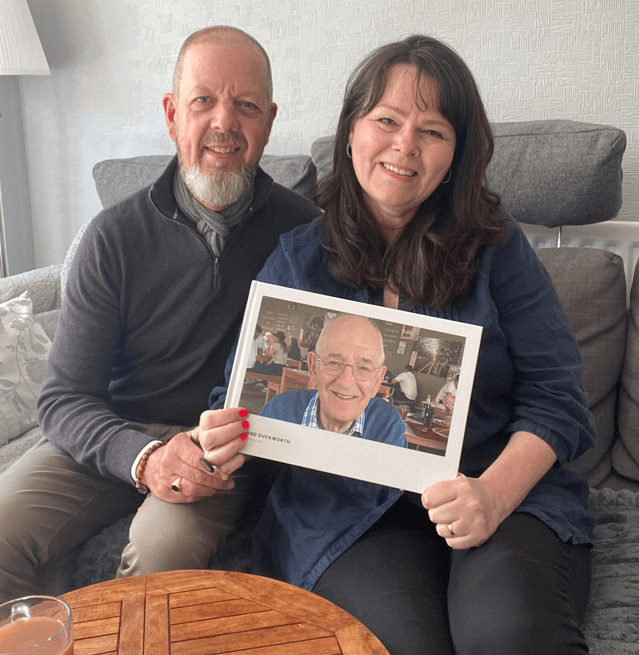
Some families also keep the stories in a printed Memory Book. Andrea, from Dudley, has one about her dad.
Frequently asked questions.
How long should a eulogy be?
How do you start a eulogy?
What if I cry while giving the eulogy?
Can more than one person give a eulogy?
Should a eulogy mention the difficult parts of someone’s life?
Sources
- National Association of Funeral Directors (NAFD Funeral Directory) · How to Write a Eulogy (25 February 2026, reviewed 7 May 2026)
- Humanists UK · How to Write a Funeral Speech (Eulogy): A Step-by-Step Guide (17 April 2025)
- Cruse Bereavement Support · Helpline (accessed October 2026)